4. Irimi and tenkan – entering and turning
Accepting energy: listening, picking it up and being ready for a change of perspective
In aikido
The irimi and tenkan footwork combination is the basis of many aikido techniques. With the irimi step, the defender enters directly into the attacker’s energy. He takes a step forward towards the aggressor and slightly to one side to avoid exposing himself to the aggressor’s energy head-on. ‘Picking up’ his energy in this way brings the energies of the attacker and defender into contact. Rather than being blocked, the forces are able to blend together in a combined movement. It takes a certain amount of courage to execute the irimi movement against a powerful attacker. However, it can be the necessary, firm response to his action.
After entering using the ‘picking-up’ step and establishing contact, the tenkan movement is often performed. Tenkan is a turning step to the outside in which the defender pivots 180 degrees. This has two effects: firstly, there’s no longer anyone standing at the point the attacker is aiming at; secondly, the defender is able to view the situation from the attacker’s perspective.
The defender can channel the combined energies into circular paths – into a throw, a grab or back towards the attacker. Which action he chooses and how strong it is, depend on the intensity of the attack and should be proportionate to the overall situation.
In the exercises involving irimi and tenkan, the techniques of gently taking in and redirecting the energy of an attack – the basic principles of aikido – can be immediately seen and felt.
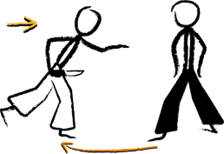
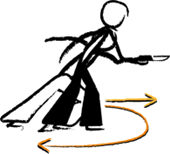
The defender sidesteps a knife attack and then immediately turns 180 degrees, from which position he can apply defensive techniques.
In everyday life
When we feel under attack by words or actions, it’s very tempting to react with an impulsive defence. The Aiki Principle teaches us not to do this – and, with a little practice, we will succeed. We’re then able to detect the energy, pick it up and work with our opponent to guide it in a direction that’s beneficial for both sides.
Countering with an irimi step means approaching the other person with alert interest, without allowing ourselves to be influenced by a potentially aggressive statement, be it an argument, a threat, a lie, an insult or even flattery. It also means actively listening to the other person. By doing so, we establish a kind of contact that allows the energy to flow on. If we were to immediately counter the other person with our view of things, the situation would quickly be blocked at the level of ‘force against force’ or ‘argument against argument’. This is something we should avoid.
In most cases, the next move we make is the tenkan step. Figuratively speaking, we turn 180 degrees and stand on the other person’s side for a moment. Consequently, we see the situation as he or she sees it. It may well be that we become aware of a misunderstanding. We may also realise that their concern is justified. Or it may become clear to us that we actually provoked the reaction. How the flow of energy continues depends on the result of our change of perspective.
This is where mental flexibility comes into play. It makes a big difference whether we have to respond urgently – perhaps in order to defend ourselves – or whether we can take our time, as is the case with written correspondence, for example. In ideal circumstances, we have enough time to wait for a response from our intuition. In other words, we can think deeply about the problem, then let it go and sleep on it. It’s often within our power to take this time with a certain degree of calmness. If we don’t have this luxury, we can at least mentally weigh up the pros and cons and then make a conscious decision in favour of one path. However, in instances that call for immediate action, our mind’s orientation comes into play. That is to say, our entire world view, with its values, conscious convictions and unconscious beliefs, takes over. And it’s in precisely these cases that the conscious inner orientation described in the chapter on ‘ai’ is so important!
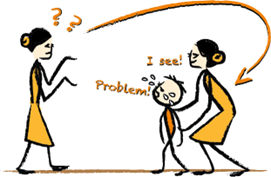
- The following picture shows a child loudly expressing his displeasure. His mother goes to him and sees the situation from his point of view. This enables her to recognise the real cause of the problem: tiredness, not getting enough attention, unfairness, a power struggle or something of that kind. Together, they channel the energy in a suitable direction.
- A truck driver has to drive through the same neighbourhood to a construction site multiple times. Each time, he concentrates but drives quickly. A local man approaches him and complains about what he considers to be excessive speed, saying that this poses a danger to children. The driver doesn’t immediately reject the criticism with counterarguments or justifications. He’s open to his critic’s arguments, listens to him and considers his point of view. Although he knows that he has professional driving skills and is very present, he understands the resident’s concerns. He thanks him and assures him that he will keep to a slower speed in future.
- In springtime, a farmer drives his mower into his meadow, which is located below a forest. A local resident approaches him, stands by his side and explains that there is a fawn lying in the upper part of the meadow. The farmer breaks off his work and the two set off together in search of the young animal. Taking up a position at another person’s side is therefore also an invitation for them to share our point of view.
- After an accident, a cyclist lies injured on the road. The next driver to pass that way stops, approaches him and speaks to him. He takes stock of the whole situation first and considers the casualty’s opinion before calling for help.